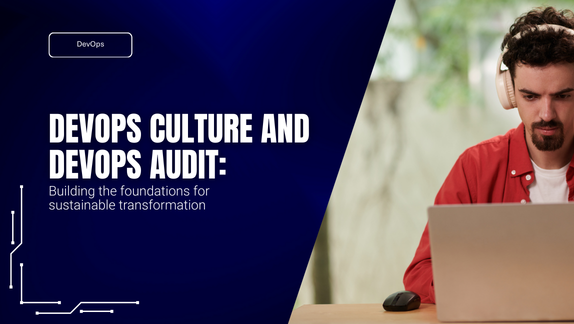
DevOps culture and DevOps audit: assess your DevOps maturity, identify risks and build strong foundations for sustainable transformation.
During a conference dedicated to modern devops practices, our experts Lionel Schaming and Romain Darie from Technology & Strategy, together with Florian Ruynat and Jean-Loïc Hervo from our entity Agaetis, shared a strategic and operational vision of devops.
One key message quickly emerged: devops transformation does not start with tools, but with culture, alignment, and a clear understanding of existing practices.
→ Watch the full conference replay on youtube :
Devops is still too often perceived as a purely technical approach based on containers, CI/CD pipelines or orchestration platforms. In reality, these tools only support a much deeper transformation. Devops is first and foremost a cultural shift, redefining collaboration, responsibility and operational ownership.
This culture is built on breaking down the traditional silos between development and operations teams. Applications are no longer “handed over” to operations at the end of a project; they are designed, deployed and operated collaboratively. The well-known principle “you build it, you run it” reflects this shared responsibility, reinforced by continuous improvement practices such as blameless post-mortems.
Automation, performance measurement and knowledge sharing strengthen this culture, but they can never replace it. Without organizational alignment and shared accountability, devops tools alone cannot deliver sustainable value.
As IT environments grow more complex—with microservices, Kubernetes, hybrid cloud and multi-cloud architectures—organizations often lose visibility into their own systems. Pipelines multiply, responsibilities become blurred, and risks increase, frequently without being clearly identified.
A devops audit addresses this challenge by providing an objective maturity assessment of existing practices. It evaluates tooling, automation, CI/CD pipelines, security integration and governance, while also analyzing collaboration models and operational processes.
Rather than producing a purely technical report, a well-executed devops audit delivers a holistic view of the organization. It highlights gaps between strategy and execution, identifies risks and inefficiencies, and defines a clear roadmap for improvement, balancing short-term quick wins with long-term transformation initiatives.
One of the key benefits of a devops audit is its ability to replace assumptions with measurable facts. By analyzing delivery metrics, deployment performance and operational indicators, organizations gain a reliable foundation for decision-making.
This increased visibility enables IT leaders to prioritize initiatives, improve quality and security, and align devops practices with business objectives. The audit becomes a strategic tool for driving continuous improvement and long-term performance.
Successful devops transformation is rooted in culture and shared responsibility. A devops audit provides the clarity and structure needed to build these foundations, enabling organizations to evolve confidently before scaling automation or cloud adoption.
In the next article, we explore how these foundations translate into cloud environments through Infrastructure as Code, gitops and devsecops.



Women in industry, leadership, and diversity: discover how Technology & Strategy drives inclusion and supports women’s careers in the industrial sector.
READ MORE
T&S developed SIRIUS for Cryostar, boosting ITP/QCDB productivity, reducing errors by 80% and eliminating vendor dependency.
READ MORE
Strengthen Embedded Linux security with best practices like attack surface reduction, access control, and security by design. Discover how Technology & Strategy helps organizations build resilient, secure systems.
READ MORE
.svg)

.svg)
.svg)
.svg)